
NTC
NTC - Negative Temperature Coefficient resistors is used in many places for measuring … temperature.
An NTC is a resistor which resistance is depended of temperature.
As name indicates resistance drops with increasing temperature
The relation is nonlinear as seen on the figure just below.
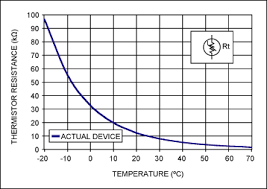 |
NTC resistance temperature relationship
|
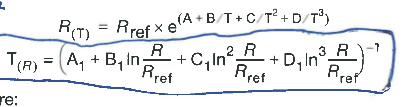
The 4th order approximination formula
Steinhart and Hart went public with the model in 1968. (wikipedia
You might see variants where the second order part is omitted bq it is much smaller than the first an third order part.
 |
|
Normal way of operation
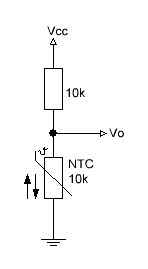
The schematics below shows a standard setup.
By use of a voltage divider its easy to calculate the resistance of the NTC when knowing supply voltage
 |
|
About proper selection of resistor in series with the NTC
Take a look at the figure below for at 10 kOhm NTC
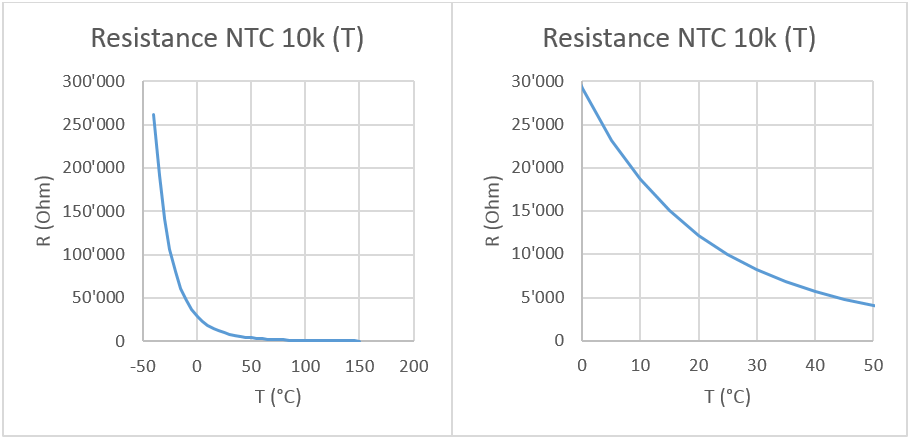 |
Resistance for an NTC for temperature interval -50C to 200C and 0C to 50C
|
Schematic  -  from above
---------------

Rldr  == resistance of LDR


Vo                  =    Vcc  * ( Rldr / (Rldr + R) )

Vo * (Rldr + R)     =    Vcc * Lldr

Rldr * ( Vcc - Vo ) =    R * Vo

Rldr                =    R  * ( Vo /( Vcc - Vo) )

QED

comment: you need to know Vs and R
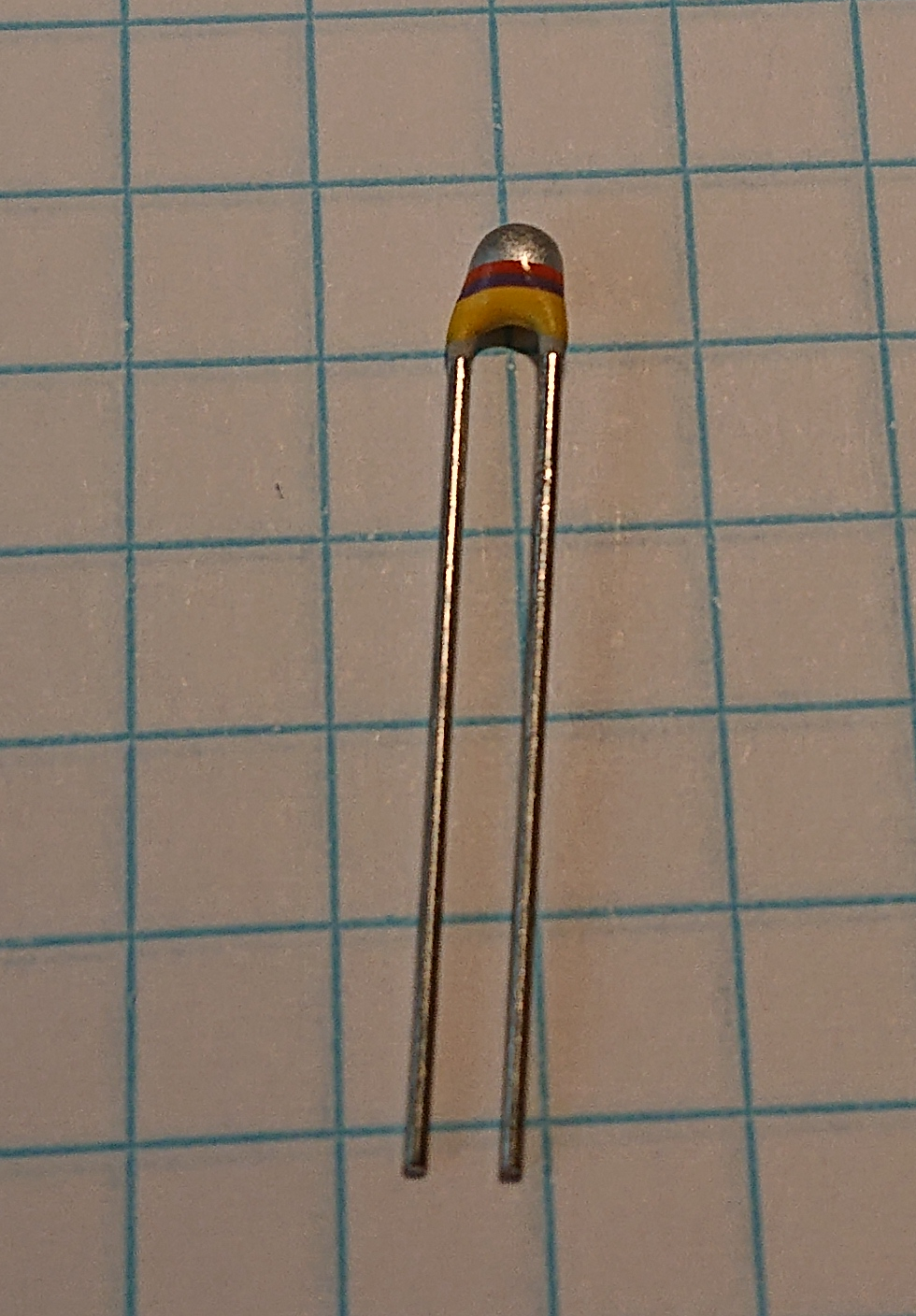 |
A small NTC of value 47 kOhm (color coded)
|
Add info
In the datasheet just below you will find the approximation for calculation of temperature from measured resistance.
Its a 4th order approximation
Arduino code
See
ntc.zip for a library and a small demo